
 health
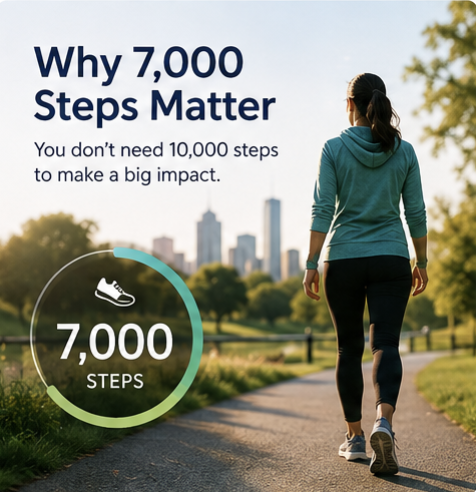
Why 7,000 Steps Matter
Why 7,000 Steps Matter
You don't necessarily need 10,000 steps a day to make walking worthwhile.
For years, 10,000 steps has been treated almost like a magic number.
Walk 10,000 steps and you've had a good day. Miss it and your fitness tracker makes you feel as though you've failed.
The science is more encouraging.
Research suggests that meaningful health benefits can occur at step counts below 10,000 — and simply moving more than you do today can matter.
Where did 10,000 steps come from?
The 10,000-step target wasn't originally created as a medical recommendation.
It became popular following a Japanese pedometer marketing campaign in the 1960s and later became a convenient, memorable fitness goal.
That doesn't make 10,000 steps bad. Walking that much can be an excellent goal for many people.
It simply isn't a universal threshold separating "healthy" from "unhealthy."
What does the research say about 7,000?
A study published in JAMA Network Open followed more than 2,000 middle-aged adults and examined their daily step counts.
People taking at least 7,000 steps per day had a substantially lower risk of death during the follow-up period compared with people taking fewer than 7,000 steps.
Importantly, the study doesn't prove that exactly 7,000 steps causes longer life, and 7,000 isn't a magic number.
Instead, it adds to a growing body of research suggesting something much more useful:
More movement helps, even when you don't reach 10,000 steps.
Your starting point matters
Imagine two people.
One averages 2,500 steps per day.
The other averages 8,000.
For the first person, moving toward 4,000 or 5,000 steps may represent a major improvement in daily activity.
For the second, adding another 1,000 steps may be a smaller change.
That's why your own baseline matters.
Instead of immediately chasing an arbitrary number, first understand how much you currently move.
Then improve gradually.
Walking doesn't have to be a workout
Your steps accumulate throughout the day.
A ten-minute walk after lunch.
Taking the stairs.
Walking while you're on a phone call.
Parking slightly farther away.
Walking around the house.
An evening walk after dinner.
It all counts.
And walking is particularly useful because it requires little equipment and can fit naturally into everyday life.
Don't let the goal become the problem
Fitness goals should encourage movement, not create anxiety.
If you finish today with 6,400 steps instead of 7,000, the day wasn't wasted.
Likewise, reaching 10,000 steps doesn't erase the importance of sleep, nutrition, strength, cardiovascular fitness and other aspects of health.
Think of steps as one useful signal among many.
HealthVox Tip
Start with your current average. If you're averaging 4,500 steps, try 5,000 or 5,500 before jumping straight to 10,000.
Your best step goal may simply be a little more than yesterday.
HealthVox provides health and wellness information and is not a substitute for professional medical advice, diagnosis or treatment.