
 health
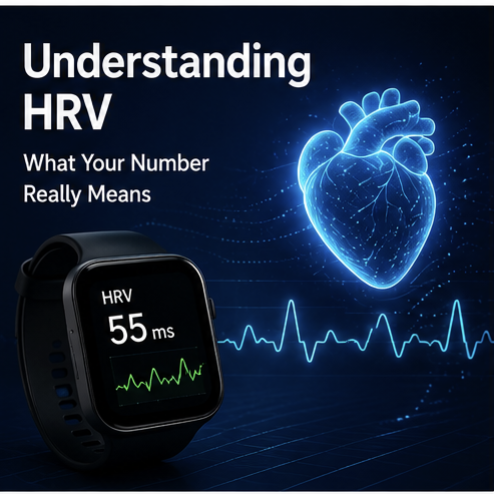
Understanding HRV: What Your Number Really Means
Understanding HRV: What Your Number Really Means
Your heart doesn't beat like a perfectly timed metronome — and that's a good thing.
If your heart rate is 60 beats per minute, you might imagine your heart beating exactly once every second.
In reality, the time between individual heartbeats changes slightly.
That variation is called Heart Rate Variability, or HRV.
What does HRV measure?
HRV measures variation in the time between consecutive heartbeats, usually measured in milliseconds.
Those tiny changes are influenced in part by your autonomic nervous system — the system that helps regulate processes such as heart rate, breathing and digestion without you consciously controlling them.
Two important branches of this system are often described as:
Sympathetic activity — associated with alertness and the body's "fight or flight" response.
Parasympathetic activity — associated with rest, recovery and the body's "rest and digest" response.
HRV can provide a window into how these systems are interacting.
Is higher HRV always better?
Not necessarily.
HRV varies enormously between people.
Age, fitness, genetics, sleep, medications, illness, alcohol, exercise and many other factors can influence it.
That means comparing your HRV with your friend's HRV isn't particularly useful.
An HRV of 60 ms isn't automatically "better" than 40 ms without context.
Your own baseline and trend are usually more useful than somebody else's number.
Why does HRV change?
You may notice your HRV changing after:
-
Hard exercise
-
Poor sleep
-
Psychological stress
-
Alcohol consumption
-
Illness
-
Travel
-
Changes in recovery
Athletes sometimes use HRV trends as one input when thinking about training and recovery.
But HRV shouldn't be interpreted in isolation.
A lower-than-usual reading doesn't necessarily mean something is wrong, and a high reading doesn't automatically mean you're perfectly recovered.
One day versus a trend
This is where wearable health data becomes particularly useful.
Suppose your normal HRV fluctuates between 48 and 58 ms.
One morning it's 43.
That single reading may not mean much.
But if your average remains noticeably below your normal range for a week while your sleep has also declined and your resting heart rate has increased, the overall pattern becomes more interesting.
The context matters.
Don't chase your HRV score
HRV is best treated as information rather than a competition.
You don't need to "win" HRV.
Instead, look at how your number responds to your habits.
Does better sleep correspond with your normal HRV?
What happens after particularly difficult workouts?
What happens during stressful weeks?
Over time, you can start learning what your own patterns look like.
HealthVox Tip
Don't judge your health from today's HRV alone.
Use HealthVox to compare your HRV with your own historical baseline, alongside sleep, activity, resting heart rate and other health signals.
Your trend tells a better story than a single number.
HealthVox provides health and wellness information and is not a substitute for professional medical advice, diagnosis or treatment.