
 health
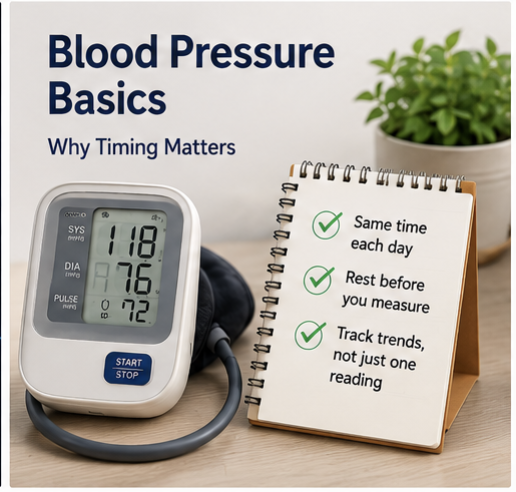
Blood Pressure Basics: Why Timing Matters
Blood Pressure Basics: Why Timing Matters
Your blood pressure isn't a fixed number. It changes throughout the day.
That's one reason two readings taken several hours apart can look different — even when nothing is necessarily wrong.
Understanding when and how you measure blood pressure can make your readings much more useful.
Blood pressure naturally changes
Blood pressure responds constantly to what your body is doing.
It can change with:
-
Physical activity
-
Stress
-
Caffeine
-
Smoking
-
Medication
-
Sleep
-
Body position
-
Time of day
Blood pressure commonly follows a daily rhythm and may be higher during waking hours than during sleep.
That's why comparing readings taken under completely different conditions can sometimes be misleading.
Consistency makes comparison easier
If you're monitoring your blood pressure at home, try to measure under similar conditions.
The American Heart Association recommends taking readings at the same time each day when home monitoring has been recommended.
Your healthcare professional may suggest a specific schedule depending on why you're monitoring.
The goal isn't to find the lowest possible reading.
It's to create comparable measurements over time.
Technique matters too
Before taking a reading, sit quietly for at least five minutes.
Avoid exercise, smoking and caffeinated beverages for about 30 minutes beforehand.
Sit with:
-
Your back supported
-
Feet flat on the floor
-
Legs uncrossed
-
Your arm supported
-
The cuff at heart level
Don't talk or use your phone while measuring.
The American Heart Association recommends a validated automatic upper-arm cuff for home monitoring.
Cuff size matters too. A cuff that doesn't fit correctly can affect the result.
Don't overreact to one reading
One unusual reading doesn't necessarily mean your blood pressure has permanently changed.
If you receive an unexpectedly high reading, follow the instructions provided by your healthcare professional and your blood pressure monitor.
For routine monitoring, keeping a history of readings provides far more information than looking at one number.
Your healthcare professional can use that history to understand your overall pattern and determine whether further evaluation is needed.
Think trends, not snapshots
Imagine these readings:
Monday: 128/79
Tuesday: 131/81
Wednesday: 127/78
Thursday: 129/80
Now compare that with one isolated reading of 139/84 taken while you were rushing out the door.
The series provides much more context.
That's one of the advantages of tracking health data digitally — you can move from individual numbers toward patterns.
HealthVox Tip
Take your readings consistently and let HealthVox build the timeline.
Instead of asking:
“Was today's number good or bad?”
Try asking:
“What direction is my blood pressure moving over time?”
If you have been diagnosed with high blood pressure or have been given specific monitoring instructions, always follow your healthcare professional's recommendations.
HealthVox provides health and wellness information and is not a substitute for professional medical advice, diagnosis or treatment.